
The government has also set targets for the next 25 years. We are working on the target of becoming a $5-10 trillion economy as well as taking exports to a record high, he said.

'Rainfall does not appear to have a statistically significant impact on foodgrain production since the last few years, which contrasts with the traditional view of India's heavy reliance on monsoon rains for agriculture.'

The most striking features of this Budget was its focus on simplification and improving the ease of doing business in India, asserts Kaku Nakhate.
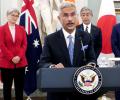
If the only superpower, which calls India an ally, sees the region through an India-Pakistan prism, it is unacceptable. Rather than endorse India's sphere of influence, this undermines it, asserts Shekhar Gupta.

'During his stint as prime minister, he got 270 million people out of poverty.' 'This, according to the World Bank, is the fastest compression of poverty anywhere in the world.' Arvind Mayaram, the former finance secretary, recalls his encounters with Dr Manmohan Singh.

The country's per capita income is likely to grow by close to 70 per cent to $4,000 by fiscal 2030 from $2,450 in fiscal 2023, helping it become a middle-income economy with $6-trillion GDP, more than half of which will be coming in from household consumption, says a research report. Per capita income/GDP has risen from $460 in fiscal 2001 to $1,413 in fiscal 2011 and further to $2,150 in fiscal 2021. The biggest growth driver will be external trade which may nearly double to $2.1 trillion by 2030 from $1.2 trillion in fiscal 2023 when the GDP printed in at $3.5 trillion, Standard Chartered Bank said in a weekend report which assumes a 10 per cent nominal GDP growth annually from now on.

Economic Survey which was tabled in the Parliament on Wednesday projects 6.1 to 6.7 per cent growth rate for 2013-14.

'It brings precarious peace because the red lines have shifted. 'The next Pahalgam attack would mean a full scale war.'
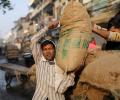
India's economy grew 7.8 per cent in the March quarter, pushing up the annual growth rate to 8.2 per cent, according to official data released on Friday. Growth in the January-March period was lower than the 8.6 per cent expansion in the December quarter.
Finance Minister Pranab Mukherjee today said the global slowdown will impact India's growth prospects, but expressed hope that inflation will start moderating from December.
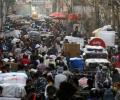
For India to transform into a high-income country with a projected gross domestic product (GDP) of $23-35 trillion, will need a sustained annual growth of 8 per cent to 10 per cent. This will be powered by India's demographic dividend, technological innovation, and sectoral transformation, according to the "India@2047: Transforming India Into A Tech-Driven Economy" report by Bain & Company and Nasscom. By 2047, the services sector is expected to contribute 60 per cent of India's GDP, while manufacturing will account for 32 per cent, both playing a pivotal role in economic expansion.
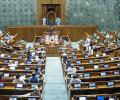
The deportation of Indians from the United States, deaths in the Maha Kumbh stampede and the joint Parliamentary committee report on the Waqf bill were among the issues that led to heated exchanges and some disruptions in an otherwise smooth first part of the Budget session that ended on Thursday.

India and the United States will be signing a new defence framework during Prime Minister Narendra Modi's ongoing visit to the US, which will give a further fillip to the partnership between the two countries, a senior White House administration official said on Thursday.

Tata Steel was the biggest loser in the Sensex pack, sliding 8.59 per cent, followed by Tata Motors, Larsen & Toubro, Adani Ports, IndusInd Bank, Tech Mahindra, Reliance Industries, Sun Pharmaceutical, HCL Technologies, Tata Consultancy Services, Infosys, and NTPC, were the major laggards. On the other hand, Bajaj Finance, HDFC Bank, Nestle India, ICICI Bank, ITC, Asian Paints and Axis Bank were among the gainers.
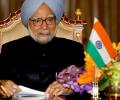
Hailed as the architect of India's economic reforms, former prime minister Manmohan Singh in one his last interviews had said in 2019 that the country's economy was 'over-regulated', the government exerted control and interferences were aplenty with even regulators having 'morphed into controllers'.
He hoped parliament would approve the real estate regulator and land acquisition bills in its monsoon session

'Adventure travel, cultural tours, and wellness retreats are in high demand.'
According to the GDP data, the Indian economy recorded a growth rate of 7.8 per cent during the first half of 2008-09, down from 9.3 per cent during the corresponding period last fiscal.

In its highest ever reduction in seller fees, ecommerce giant Amazon India has introduced zero referral charges on over 12 million products on its platform that are priced below Rs 300. The move is aimed at boosting seller growth on Amazon.in and supporting hundreds of thousands small businesses across the country.

The report said South Asia is expected to be the fastest-growing region.
Dismissing the CSO (Central Statistical Organisation) projection of 4.4 per cent GDP growth this fiscal, Planning Commission member N K Singh said the economy will grow by six per cent this year.\n\n\n\n

Can a culture survive as a way of life, even as the language and writing at its core, alter with time? Can we be rational and Malayalee or do we have to necessarily be religious and proudly cultural to be Malayalee? asks Shyam G Menon.
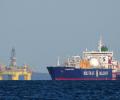
India, the world's third largest oil consuming and importing nation, spent 112.5 billion euro (about Rs 1.5 lakh crore) on buying crude oil from Russia since the start of the Ukraine war, a European think tank said on Thursday. The Centre for Research on Energy and Clean Air (CREA) released a report on payments to Russia for fossil fuels since February 24, 2022. "According to our estimates, since the beginning of the war, Russia earned EUR 835 billion in revenue from fossil fuel exports," it said.

India can become a $6.7 trillion economy by 2031, from $3.4 trillion currently, if the country clocks an average growth of 6.7 per cent for 7 years, an S&P Global report said on Thursday. India had clocked a 7.2 per cent GDP growth in 2022-23 fiscal. But a global slowdown and lagged effect of a policy rate hike by RBI could slow down growth to 6 per cent in the current fiscal, S&P Global said in a report titled 'Look Forward: India's Money'.
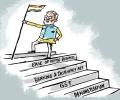
India's GDP expanded 13.5 per cent in the April-June quarter, the quickest pace in a year, to retain the world's fastest growing economy tag but rising interest costs and the looming threat of a recession in major world economies could slow the momentum in the coming quarters.
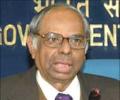
I think the overall growth rate of the economy will be between 5.5-6 per cent, says C Rangarajan.

The outlook is improving and that mostly reflects the fact that the new government has pledged to prioritise economic reforms.
Indian economy is projected to grow 7.1-7.6 per cent in the current financial year despite shifting geopolitical realities across the world, a report said on Wednesday. In its India's economic outlook - July 2022 report, leading consultancy Deloitte India said that as 2021 was coming to a close, there was optimism in the air but the optimism received a jolt early this year as a wave of Omicron infections swept through the country and Russia's invasion of Ukraine happened in February. "These events aggravated the pre-existing challenges such as surging inflation, supply shortages, and shifting geopolitical realities across the world with no definite end in sight.

The poll of over 30 economists, taken in the past week, showed Asia's third largest economy will expand 7.8 percent in the fiscal year ending March 2017.

Budget 2025 lays down a transformational roadmap for India's digital and economic future, focusing on AI-driven enterprise modernisation, workforce skilling, and sustainable innovation. With bold investments in AI, digital infrastructure, and ease of doing business, the government has set the stage for businesses to scale, innovate and compete on a global level.

India's economy is likely to grow by 6.5 per cent in the current and the next financial year, an EY report said, attributing lower than anticipated expansion in the September quarter to fall in private consumption expenditure and gross fixed capital formation. Real GDP growth eased to a seven-quarter low of 5.4 per cent in July-September -- the second quarter of the current 2024-25 fiscal year.

The volume growth of India's FMCG industry has slowed down in the March quarter to 5.1 per cent, driven by increased consumer purchases of small-value packs, according to the latest report from data analytics firm NielsenIQ. Volume growth is slowing across categories, and non-food segments are still outpacing food in the FMCG sector.
Finance Minister P Chidambaram on Wednesday said he was confident that the economy will grow close to 8 per cent this fiscal, although the Prime Minister's Economic Advisory Council saw gross domestic product expansion slowing to 7.7 per cent.

Finance Minister Nirmala Sitharaman on Saturday said the government will arrange identity cards and registration on the e-Shram portal to assist 1 crore gig workers. Presenting the Union Budget 2025-26, the finance minister also said a scheme for the socio-economic upliftment of urban workers will be implemented.

After declining to a three-year low in FY24, the private sector investment is expected to fall further in the current financial year, India Ratings said in a research note.. The investments in the private sector are likely to plummet to below 11 per cent of the GDP in FY25, based on the trends from the latest national accounts data and company fillings, it noted.

The economy is likely to log in a tepid 6 per cent growth next fiscal, in line with the consensus estimates, rating agency Crisil said on Thursday. The agency also sees the economy averaging a growth rate of 6.8 per cent over the next five fiscals. Crisil further said it expects the corporate revenue to log in double-digit rise again next fiscal.
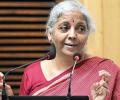
'The finance minister has done as much as she can when you look into the fiscal constraints she had.'
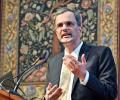
There is a "misperception" among the administration around deregulation, wherein digitisation is confused with deregulation, Chief Economic Advisor V Anantha Nageswaran said on Tuesday. Speaking at an event organised by alternative investment industry's lobby grouping IVCA in Mumbai, Nageswaran stressed that what is essential is to do away with needless regulations, whether they are to be complied with online or offline.
